
Sending Mail to Inmates in Canada
A guide to sending mail and letters to incarcerated individuals in Canada.
Why is mail so important?
Sending physical letters and mail to incarcerated loved ones is a simple way to maintain connection, offer emotional support and remind them they are not forgotten.
How to Send Letters
Addressing the Envelope
Print legibly and ensure your loved one’s name is spelled correctly. Below their name, write “c/o Institution Name” and then the institution’s address.
Example:
John Smith
c/o Drumheller Institution
Highway #9
PO Box 3000
Drumheller, AB T0J 0Y0
Do not forget to include your return address in the top left of the envelope.
Postage Stamps
Stamps can be costly, but ensuring you’re not over the weight limit of letter mail is important if you don’t want your mail returned by Canada Post.
Refer to the Canada Post stamp page for standard letter mail rates and weights. If you are sending mail from outside Canada, research local postage rates.
In-Person Mail Delivery
You may be able to hand-deliver mail to the institution; confirm with the institution first.
What To Send
Letters
Writing letters can be time-consuming, but you can also spread it out over a few days, writing an “entry/message” every day and then mail it.
Tips
Do not use perfumes, decorative stickers, tape, Post-It notes or felt markers (see below for prohibited items).
Greeting Cards
Cards can be a fun way to celebrate important or relevant days, such as birthdays or holidays. It can also just be nice to send a “Hi” or “Thinking of you” card as a reminder that you haven’t forgotten about your loved one.
Tips
For more “fun”/playful greeting cards, check Etsy or Redbubble.
If you plan on sending photos, a greeting card envelope will fit most generic-sized photos perfectly and prevent them from being bent in the mail.
Remember that you cannot send anything with adhesives, so that “fun pop-up card” that has adhesive on it, or a handmade card that you glued, may be denied
Avoid cards that have glitter or any texture to them
Photos
Photos of yourself, family members, etc. can be a nice way for your loved one to “see” you.
Tips
Polaroid photos are not allowed
You can get photos printed affordably at your local Walmart, London Drugs, etc.
If you find yourself sending a lot of photos throughout the duration of the sentence, consider purchasing a photo printer such as the Canon Selphy or Kodak Dock
Photos with a sticker backing are not permitted, many of the “mini photo printers” that use Zink technology only print on sticker photo paper
Mail Items Not Permitted
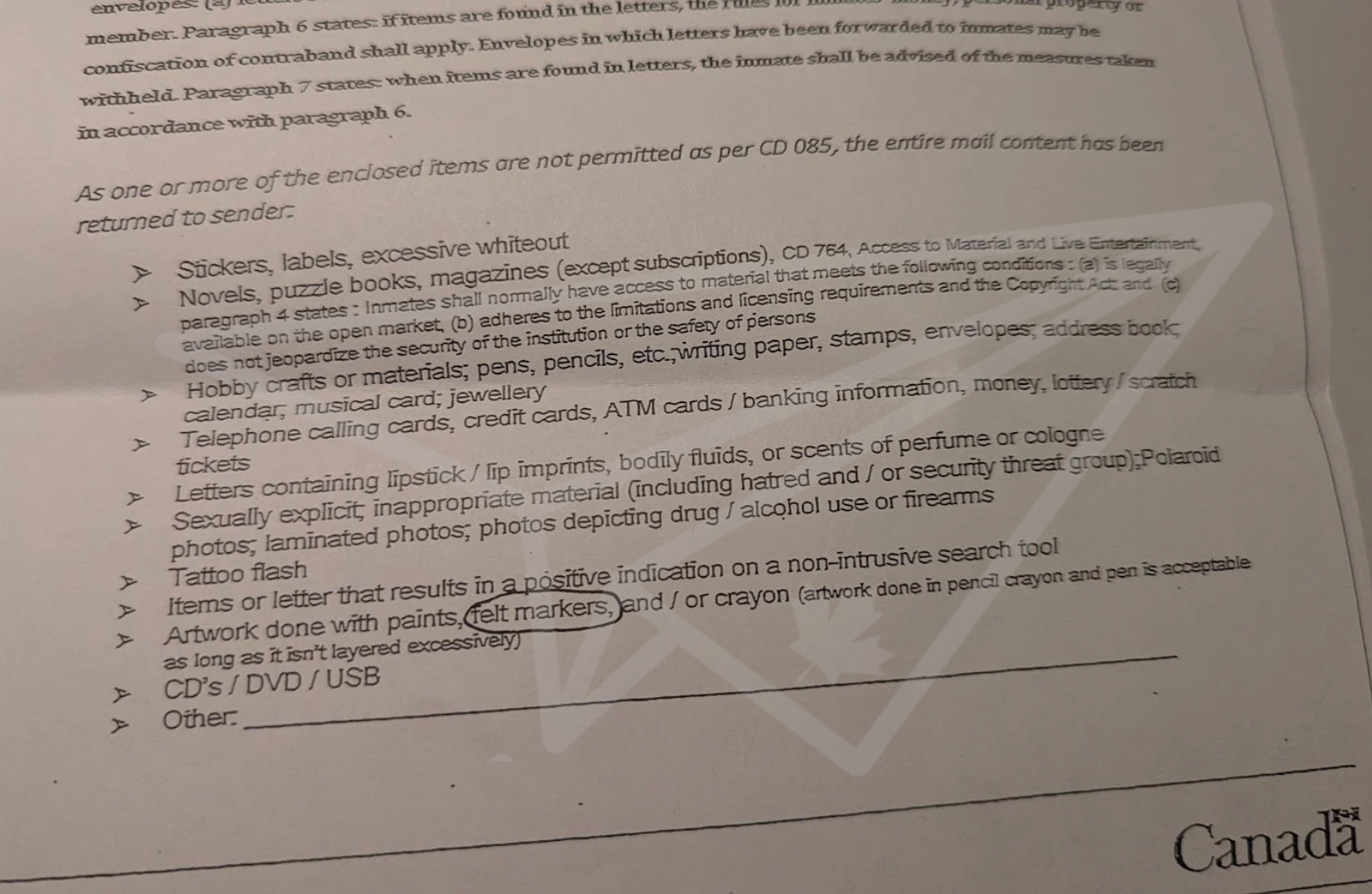
Form notifying sender of mail of an item that was not permitted.
While it may be exciting to send more than just letters, cards, or photos, it's important to remember that there are strict rules about what can be included in mail to your loved one. In most cases, if an unapproved item is found, the entire envelope—including any permitted contents—will be returned to the sender, which can be especially disappointing and frustrating.
Be sure to check the complete list of unacceptable items on the Correctional Service Canada website before sending mail.
Things to be aware of:
All mail is inspected and tested by a scanner for contraband
The institution's staff can read/open all mail addressed to inmates (as well as outgoing mail)
Mail can be turned over to the police
Still have questions about sending mail?
In order not to duplicate existing resources, it’s strongly recommended that you view the link below for more information.